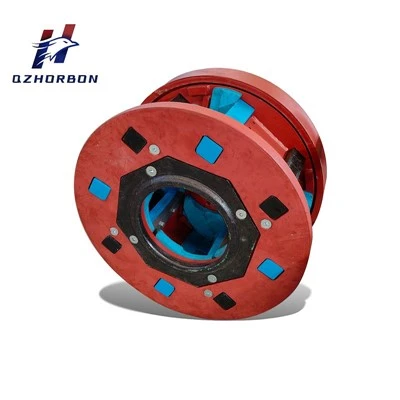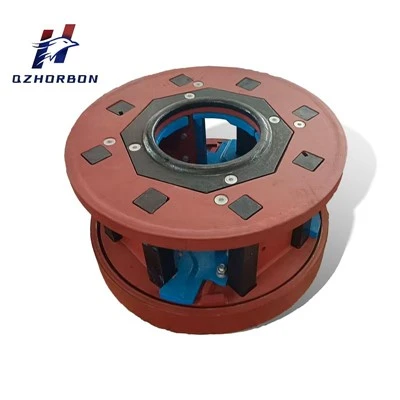


The efficiency and longevity of a crusher are significantly influenced by the performance of its V - belt pulley system. One crucial parameter in this system is the belt's wrap angle on the Crusher V - belt Pulley. As a well - established Crusher V - belt Pulley supplier, I understand the importance of accurately measuring this angle to ensure optimal operation and prevent premature wear and tear. In this blog, I will share some effective methods to measure the belt's wrap angle on a Crusher V - belt Pulley.
Understanding the Importance of Wrap Angle
Before delving into the measurement methods, it's essential to understand why the wrap angle matters. The wrap angle is the angle subtended by the arc of contact between the belt and the pulley. A larger wrap angle allows for more frictional force between the belt and the pulley, which is crucial for power transmission. In a crusher, where high torque is often required, a sufficient wrap angle ensures that the V - belt can transfer power efficiently from the motor to the crusher mechanism without slipping.
Insufficient wrap angle can lead to several issues. Belt slipping can cause overheating, which not only reduces the efficiency of the crusher but also shortens the lifespan of the belt. Additionally, it can result in uneven wear on the belt and pulley, leading to costly replacements and downtime.
Methods for Measuring the Wrap Angle
Geometric Calculation Method
The geometric calculation method is based on the physical dimensions of the pulley system. To use this method, you need to measure the center distance between the driving and driven pulleys ($C$), the diameters of the driving pulley ($D_1$) and the driven pulley ($D_2$).
The formula for calculating the wrap angle ($\theta$) on the smaller pulley is:
[
\theta = 180^{\circ}-\frac{D_2 - D_1}{C}\times60^{\circ}
]
And for the larger pulley:
[
\theta = 180^{\circ}+\frac{D_2 - D_1}{C}\times60^{\circ}
]
Here's how you can perform the measurement:
- Measure the pulley diameters: Use a caliper to measure the outer diameter of both the driving and driven pulleys accurately. Make sure to measure at multiple points around the pulley to account for any irregularities.
- Measure the center distance: Use a measuring tape to measure the distance between the centers of the two pulleys. This measurement should be taken along a straight line passing through the centers of both pulleys.
- Calculate the wrap angle: Plug the measured values into the appropriate formula. For example, if the diameter of the driving pulley ($D_1$) is 100 mm, the diameter of the driven pulley ($D_2$) is 200 mm, and the center distance ($C$) is 500 mm, for the smaller pulley:
[
\theta = 180^{\circ}-\frac{200 - 100}{500}\times60^{\circ}=180^{\circ}- 12^{\circ}=168^{\circ}
]
Protractor - Based Method
The protractor - based method is a more direct way of measuring the wrap angle. This method requires a flexible protractor or an angle - measuring tool.
- Mark the start and end points: First, mark the points where the belt starts and ends its contact with the pulley. You can use a piece of chalk or a marker for this purpose.
- Position the protractor: Place the center of the protractor at the center of the pulley. Align one of the protractor's arms with the line connecting the center of the pulley to the start - point of the belt contact.
- Measure the angle: Read the angle on the protractor where the other arm aligns with the line connecting the center of the pulley to the end - point of the belt contact. This reading is the wrap angle of the belt on the pulley.
Factors Affecting Wrap Angle Measurement
Pulley Misalignment
Pulley misalignment can significantly affect the accuracy of wrap - angle measurement. If the pulleys are not properly aligned, the belt may not make contact with the pulley as expected, leading to an incorrect wrap - angle measurement. To ensure accurate measurement, check the alignment of the pulleys using a straightedge or an alignment tool before taking any measurements.
Belt Tension
The tension of the belt can also influence the wrap angle. A loose belt may not fully conform to the pulley surface, resulting in a smaller effective wrap angle. On the other hand, an overly tight belt can cause the belt to deform and may also affect the measurement. It's important to ensure that the belt is tensioned correctly according to the manufacturer's specifications before measuring the wrap angle.
Applications in Different Crusher Types
Cone Crusher Pulley
In a Cone Crusher Pulley system, accurate wrap - angle measurement is crucial for efficient power transmission. Cone crushers often operate under high - load conditions, and a sufficient wrap angle ensures that the V - belt can transfer the required torque from the motor to the crusher's crushing chamber. By regularly measuring the wrap angle, you can prevent belt slipping and extend the service life of the belt and pulley.
Stone Crusher Pulley
Stone Crusher Pulley systems handle the tough task of crushing large stones. The wrap angle of the V - belt on the pulley affects the overall efficiency of the stone - crushing process. A proper wrap angle ensures that the crusher can crush stones at a consistent rate, reducing the likelihood of bottlenecks and improving productivity.
Crusher V - belt Pulley
As a supplier of Crusher V - belt Pulley, I emphasize the importance of accurate wrap - angle measurement for our products. Our pulleys are designed to work in harmony with the V - belts, and a correct wrap angle is essential for achieving the best performance. By providing customers with guidance on how to measure the wrap angle, we help them optimize the use of our products and reduce maintenance costs.
Jaw Crusher Pulley
For Jaw Crusher Pulley systems, the wrap angle plays a vital role in the smooth operation of the jaw - crushing mechanism. The high - impact nature of jaw crushers requires a reliable power - transmission system. Measuring the wrap angle allows operators to ensure that the V - belt is functioning correctly, preventing unexpected breakdowns and costly repairs.
Conclusion
Measuring the belt's wrap angle on a Crusher V - belt Pulley is a fundamental task that can have a significant impact on the performance and longevity of a crusher. Whether you use the geometric calculation method or the protractor - based method, it's important to take accurate measurements and account for factors such as pulley misalignment and belt tension.
As a trusted supplier of Crusher V - belt Pulleys, I am committed to providing high - quality products and valuable technical support. If you have any questions about measuring the wrap angle or need assistance with selecting the right pulley for your crusher, please feel free to contact us for procurement and further discussions. We look forward to working with you to optimize your crusher's performance.


References
- Norton, R. L. (2004). Design of Machinery: An Introduction to the Synthesis and Analysis of Mechanisms and Machines. McGraw - Hill.
- Spotts, M. F., Shoup, T. E., & Hamrock, B. J. (2004). Design of Machine Elements. Pearson Prentice Hall.