
Most crusher operators don't replace a worn fixed jaw plate because they measured it. They replace it because output dropped, the product got coarse, or someone noticed a crack during a shutdown. By then the plate has usually been past its best for weeks, and the damage is no longer limited to the plate.
There is a better trigger than a calendar or a tonnage count: the surface of the teeth itself. A fixed jaw plate records exactly how it has been used, including feed distribution, material abrasiveness and chamber setup. If you know how to read that record, you can decide when to keep running, when to flip the plate, and when to stop and replace it. You also get a clear brief for your next purchase.
This guide explains how to read fixed jaw plate wear signs, how to judge when to replace a fixed jaw plate, when jaw plate flipping is worth doing, and what uneven jaw plate wear is telling you.

Why the Fixed Jaw Plate Wears Differently from the Swing Jaw Plate
The fixed jaw plate (also called the stationary jaw die) is bolted to the frame and does not move. The swing jaw plate moves with the pitman (the moving arm driven by the eccentric shaft). Material is crushed between them, and gravity pulls it down through a narrowing chamber.
That geometry means wear is never even. Metso's rotation guidance notes that some areas cannot avoid heavier wear, mainly because of the crushing motion, and names the lower tip of the fixed jaw plate as a typical example. The lower zone is where rock is most compressed, travel is smallest and the material is hardest on the teeth.
So the goal is not "even wear". It is to use as much of the plate as possible before the worn zone starts hurting performance. That is exactly what flipping is for.
Step 1: Read the Teeth, Not the Calendar
Whenever the crusher is stopped and locked out, check four areas of the fixed jaw plate. A flashlight, a straightedge and a tape measure are enough.
1. Tooth tips. New teeth have a defined peak. As they wear, the tips round off, then flatten into a plateau. Rounded tips are normal. Flat tips across most of the lower third mean the plate is no longer gripping rock well, and you will see more slabby, oversized pieces.
2. Valley depth. The valleys (the grooves between teeth) are what let the plate bite and release material. Measure the valley depth at the top, middle and bottom of the plate and compare with the unworn upper zone. A valley that has worn to almost nothing at the bottom, while the top still looks new, tells you the plate is ready for a flip.
3. The lower wear band. Look for a smooth, polished strip across the bottom where teeth have been ground flat. Press a straightedge along it. A visible step between this band and the still-toothed zone above shows how far wear has progressed.
4. The back and bolt holes. Surface teeth are only half the story. Check the plate back for cracks, rocking marks or bright contact spots, and check bolt holes for elongation. Loose seating deforms the plate and shortens its life, however good the teeth look. A plate with a cracked back or stretched holes should not be flipped, even if half the teeth are still usable.
Step 2: Decide Whether to Continue, Flip or Replace
Once you have read the teeth, the decision becomes simple. The thresholds below come from commonly published guidance (Metso and SBM among them). Treat them as starting points and confirm against your crusher's manual and your own material.
| What you see | Decision |
|---|---|
| Lower zone worn by roughly 30%, upper teeth intact | Plan the first flip (Metso's guidance for one-piece plates) |
| Bottom of the fixed plate worn about 2/3, bottom of the swing plate about 1/3 | Flip both plates top-to-bottom (SBM guidance) |
| Both ends worn, teeth flat across most of the face | Replace the plate |
| Cracks, back deformation, elongated holes | Replace the plate, regardless of tooth condition |
| Even, moderate wear and stable product size | Keep running, keep measuring |
When jaw plate flipping works. Flipping only makes sense if the plate was designed for it: a symmetrical tooth profile and a bolt or wedge layout that matches in both orientations. Many standard plates are symmetrical; some are not. Before you count on flipping to double your plate life, check the drawing or part number. If the plate was not designed to be reversed, flipping it will only misalign the chamber.
Flip early, not late. The most common mistake is waiting until the lower teeth are completely gone. By then the upper half has often been worn on the underside too, so the flipped plate has less usable life than you hoped. Flipping at around a third of wear in the lower zone gives you two full working halves.
Watch the swing plate too. Worn plates change the closed-side setting and the shape of the chamber, which sends extra load into the toggle plate and bearings. A badly worn fixed plate does not just cost you product quality; it costs you components that are much more expensive than plates.
Step 3: Uneven Jaw Plate Wear Is a Diagnosis, Not Just a Defect
Some unevenness is built in, but strongly one-sided or unusual wear points to a cause you can fix. Use this as a first-pass guide:
| Wear pattern | Likely cause | What to try |
|---|---|---|
| Heavy wear on one side only | Feed concentrated on one side of the crusher mouth | Centre the feed; check the feeder and chute |
| Wear only in the lower third, teeth gone | Normal geometry, long run without flipping | Flip earlier next cycle |
| Teeth filled and packed, little bite | Too many fines, or sticky or wet feed | Scalp fines ahead of the crusher; check moisture |
| Smooth polished face | Compaction, or an unsuitable tooth profile | Review tooth pitch and depth for your material |
| Rapid wear and short life overall | Plate material not matched to the feed, or poor casting | Review alloy and heat treatment with your supplier |
| Cracks or chipped teeth | Uncrushable material, loose mounting | Add tramp metal protection; check the seating |
Operators on industry forums consistently point to the same culprits for short plate life: fines packing the corrugations, compaction, abrasive feed and moisture. Water is abrasive in its own right. If your plates are failing much sooner than expected, don't simply order more of the same. First work out which of these patterns applies to you.

Step 4: Turn What You Read into a Smarter Purchase
This is where reading wear pays off for buyers and distributors, not just for the plant.
Match material to the wear pattern. Fixed jaw plates are commonly cast in high manganese steel, which hardens under impact. If your plates wear out through abrasion with little impact, or crack because of heavy impact, you may need a different alloy or heat treatment, not a bigger order. Horbon's fixed jaw plates are made with options such as high-manganese and chromium-molybdenum alloy steel, with heat treatment and precision casting, and we can adjust the alloy composition to a customer's drawing or requirement.
Match tooth profile to the feed. If you consistently see packed or polished teeth, ask about a different tooth depth or pitch. A small design change can stop compaction before it begins.
Don't have a drawing? Send us the worn plate. Many buyers, and especially distributors supplying older machines, cannot find the original drawing. Horbon can reverse-engineer from a worn part: we survey it, rebuild the model, and produce the 2D/3D drawings, typically within about three days for a first draft. If you know the original Part Number, we can produce directly from that.
Plan stock around your flip cycle. If you flip at about a third wear, you know roughly when plates will be needed, which lets you order in time rather than in an emergency. Our minimum order is five pieces, and standard production lead time is 15–30 days, so working from your wear records instead of waiting for a failure gives you room to place orders at normal lead times, not rush ones. We also keep standing stock on common items, so ask about availability if you are working to a shutdown date.
Protect the plate on its way to you. Heavy castings need rust protection and secure packing. We support customer-specific packaging, including fumigated wooden cases and iron frames, and laser-marked logos for OEM and distributor orders.
Check quality before you accept. Ask what testing sits behind the plates you buy: raw-material spectrometer analysis, HRC hardness testing, CMM dimensional checks and flaw detection are all relevant for a part that has to survive impact. Our process includes these, and third-party inspection is available on request.
A simple record makes every future order better. Photograph the plate before removal, note the hours or tonnage, the material crushed and the closed-side setting. Over a few cycles you will have a wear history that tells you which alloy, profile and flip schedule suits your site. Send it to your supplier and the conversation becomes specific, not generic.
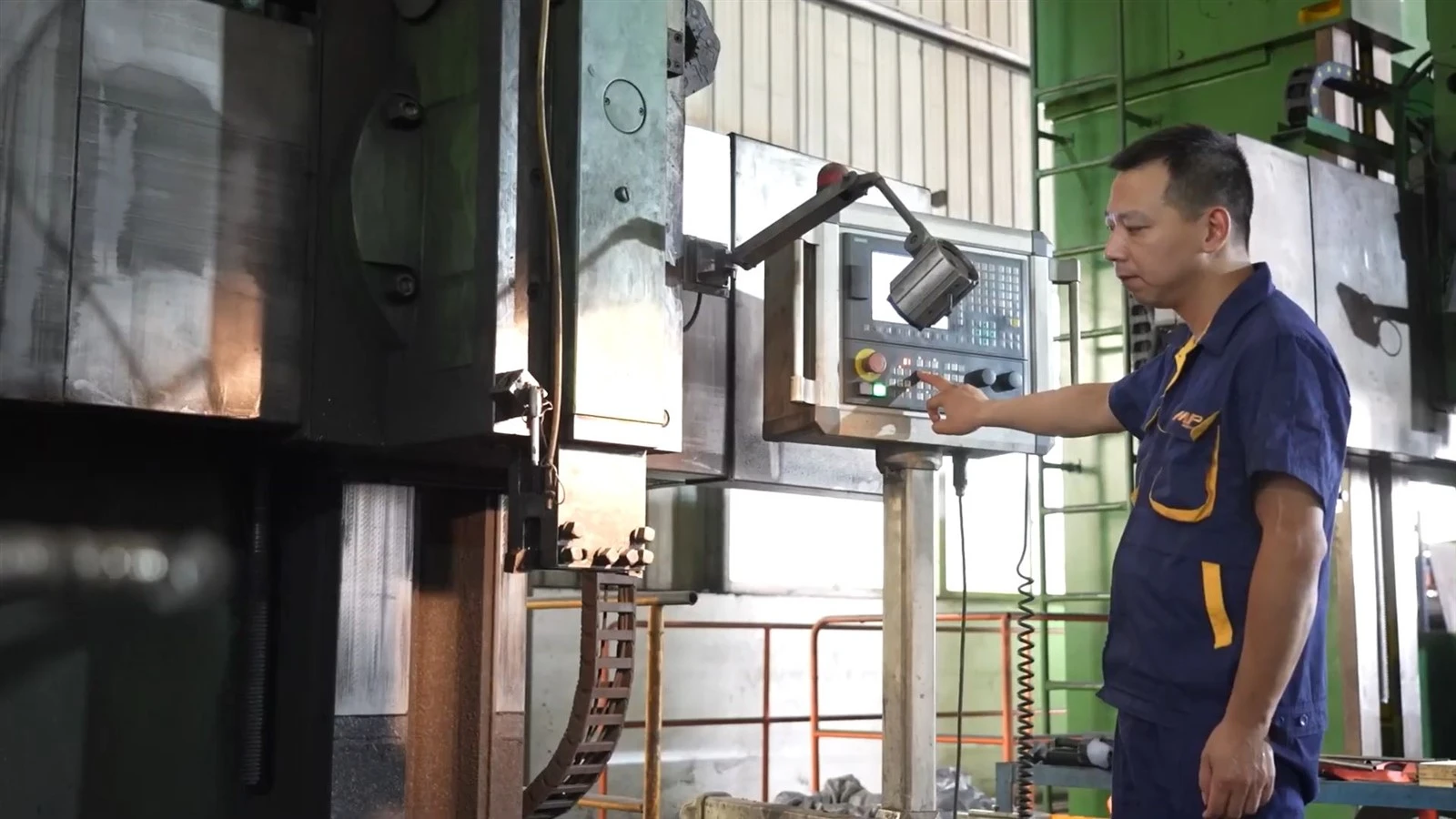
Inside Horbon's factory in Quzhou: this is where our crusher wear parts, including fixed jaw plates, are cast, machined and inspected. Our site covers about 13,000 m², with in-house capability from precision casting and heat treatment to CNC machining.
Summary: A Practical Routine
At each planned stop, check the four areas: tooth tips, valley depth, lower wear band, and the back and bolt holes.
Flip the plate when the lower zone reaches about a third of wear, provided the plate is designed to be reversed.
Replace the plate immediately if you find cracks, back deformation or stretched holes.
If wear is one-sided, packed or polished, fix the cause (feed position, fines, moisture, compaction) before reordering.
Keep photos and wear records, and use them to specify alloy, tooth profile and order quantity.
Order replacement plates before you need them, using a lead time that matches your supplier's real schedule.
If you are comparing suppliers or planning a bulk order, see our 【Fixed Jaw Plate】 page, or tell us your crusher model and send worn-plate photos via our 【custom wear parts service】.
FAQ
- How do I know when to replace a fixed jaw plate?
Replace it when the teeth are worn flat in both the top and bottom zones, when the product becomes visibly coarser, or when you find cracks, back deformation or stretched bolt holes. Common guidance suggests flipping first, at about a third of wear in the lower zone, so you don't reach replacement with half the plate unused.
- Can a fixed jaw plate be flipped?
Yes, if it has a symmetrical tooth profile and a matching bolt layout. Flipping top-to-bottom moves the worn lower zone to the top and lets you use the intact teeth. Check the drawing first; plates not designed for reversal cannot be flipped.
- Why is my fixed jaw plate wearing unevenly?
The lower zone always wears more because of how the chamber compresses material. One-sided wear usually means feed is off-centre. Packed or polished teeth point to fines, moisture or compaction. Review your feed arrangement and tooth profile before changing suppliers.
- How long does a fixed jaw plate last?
There is no single figure. Life depends on the abrasiveness and size of the material, the closed-side setting, feed control and the plate's alloy and heat treatment. The most reliable way to estimate it is to keep your own wear records from cycle to cycle.
- Can I order a fixed jaw plate if I don't have the drawing?
Yes. Send the worn plate or the original part number. We can reverse-engineer a worn part and produce a first-draft 2D/3D drawing in around three days, then produce to that drawing or to your OEM part number.