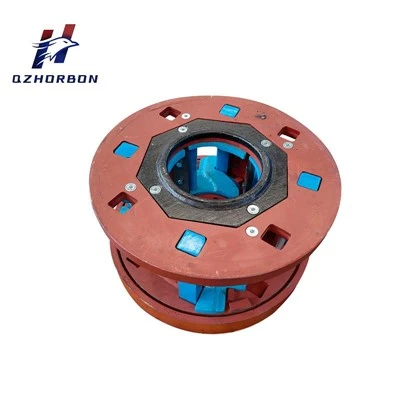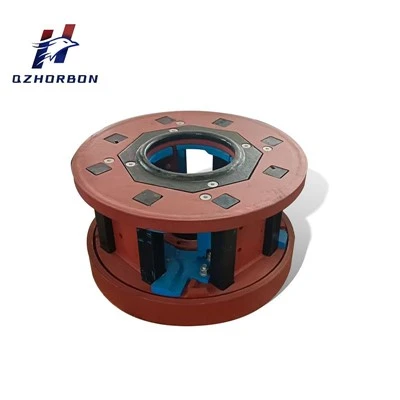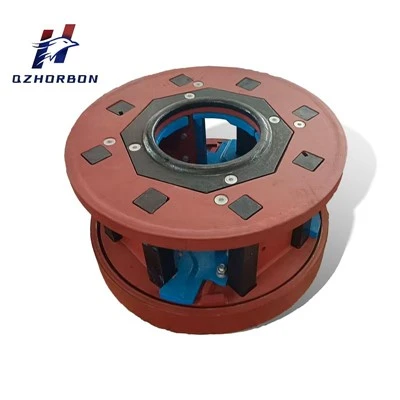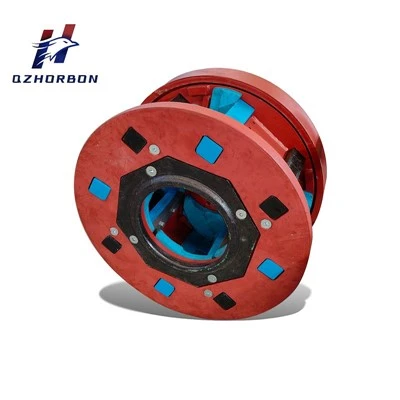


Quzhou Horbon Mining Parts Co., Ltd. is one of the leading manufacturers and suppliers of black crusher rotor in China. With abundant experience, we are committed to providing high quality customized service and OEM service to global clients. Welcome to buy advanced black crusher rotor made in China here from our factory. Contact us for quotation.
Black Crusher Rotor - Industrial-Grade VSI & Horizontal Impact Crusher Rotor Components for High-Demand Mining Operations
Built for Operations That Cannot Afford Downtime

In any crushing circuit, the rotor is the component under the greatest combined stress: rotational inertia, repeated impact loading, continuous abrasive wear, thermal cycling, and high-frequency vibration - all simultaneously, for thousands of operating hours. A black crusher rotor that fails prematurely does not just cost the price of the part. It costs the production hours lost during unplanned disassembly, the expedited freight on emergency replacements, and the downstream effect on every process that depends on crusher output.
Quzhou Horbon Mining Parts Co., Ltd. manufactures black crusher rotor assemblies and individual components for both horizontal shaft impact crushers (PFC1415P series) and vertical shaft impact crushers (MP VSI4000 series) at our 13,000 m² dedicated production facility in Quzhou, Zhejiang, China - supplying B2B clients across six continents with factory-direct parts under a single procurement relationship.
Horbon approaches crusher rotor manufacturing from this operational reality. Every material selection, every machining tolerance, every inspection step in our process exists to extend the interval between maintenance events and eliminate the unplanned failures that drive the highest cost in a crushing operation.

Rotor Platform Selection Guide
Before sourcing a replacement or upgrade rotor, the first question is crusher type. Horizontal and vertical shaft impact crushers impose fundamentally different mechanical demands on the rotor - different mass profiles, different wear mechanisms, different failure modes, and different maintenance rhythms.
Horizontal Shaft Impact Crusher Rotor - PFC1415P
Crusher drawing


High-mass rotating assembly. Hammer strike energy delivery. Fatigue and impact wear dominant.
The PFC1415P rotor converts motor torque into kinetic hammer energy. At 8,150 kg total assembly weight with four plate hammers totaling 1,791 kg, it delivers crushing force through direct high-velocity hammer contact with feed material. Structural integrity of the rotor body, shaft fatigue resistance, and hammer alloy hardness are the parameters that determine service life.
| Parameter | Specification |
| Assembly Part No. | 2105070001 |
| Rotor Diameter | Ø1368 mm |
| Total Length | 2807 mm |
| Total Assembly Weight | 8,150 kg |
| Plate Hammer Rows | 4 |
| Single Plate Hammer Weight | 447.75 kg |
| Main Shaft Weight | 670.25 kg |
| Rotor Body Weight | 4,043 kg |
| Drive Pulley Weight | 521.63 kg |
| Bearing Type | Self-Aligning Spherical Roller |
| Components in Assembly | 44 Parts |
Vertical Shaft Impact Crusher Rotor - MP VSI4000
Create a comprehensive solution for efficient human theft manag
Crusher drawing


High-speed centrifugal accelerator. Multi-surface distributed wear. Balance sensitivity dominant.
The VSI4000 4-port rotor operates at significantly higher rotational speeds than a horizontal impact rotor. Feed material enters the central eye, is metered by the distributer plate, and is accelerated through four symmetrical port channels before exiting at high velocity. No single hammer impact - instead, sustained high-velocity sliding abrasion across multiple wear surfaces distributed through each port.
| Parameter | Specification |
| Assembly Part No. | 2103030016 |
| Rotor Type | 4-Port / 4-Channel |
| Rotor Diameter | Ø840 mm |
| Rotor Height | 448 mm |
| Shaft Bore | Ø390 mm (inner) / Ø420 mm (outer) |
| Balance Feature | Static Balance Adjustment Bolt Holes |
| Components in Assembly | 25 Parts |
Component Manufacturing Detail
PFC1415P Horizontal Impact Rotor Components
Rotor Body
Precision-cast alloy steel with CNC-machined hammer slot profiles across all four rows. The hammer slot geometry must be consistent across all positions - any dimensional deviation in slot depth or angle creates uneven hammer seating that introduces rotor imbalance at operating speed. Horbon's rotor bodies are dimensionally verified by CMM before leaving the machining stage.
Forged Main Shaft
Manufactured from forged billet rather than cast steel. Forging aligns the grain structure along the shaft axis, creating superior resistance to the torsional fatigue and bending stress cycles that accumulate over millions of rotor revolutions. Journal surfaces are CNC finish-machined and heat-treated; dimensional records are maintained through the full production process.
Plate Hammers
The primary energy transfer component and the defining wear part in any horizontal impact crusher. Four hammers, each nearly half a tonne, must be produced to consistent mass to maintain rotor balance through their service life. Horbon supplies plate hammers in three material grades:
- High-Manganese Steel: Work-hardening surface behavior under repeated impact. Best suited to applications where tramp metal contamination in feed is a realistic risk - the toughness of manganese steel resists catastrophic fracture better than harder, more brittle alternatives.
- Chrome-Molybdenum Alloy Steel: Higher as-supplied hardness with good thermal stability. Preferred for consistently hard, clean feed material where maximum abrasion resistance is the priority.
- Bimetal Composite: Chromium carbide overlay on a tough alloy steel backing. Combines the hardness of a wear-resistant face with the fracture resistance of a ductile substrate - extending service intervals in the most abrasive feed conditions.
Wedge Block Assembly
Forty-eight wedge blocks per rotor secure plate hammers in their slots through a self-tightening mechanical geometry. As centrifugal force increases with rotor speed, the wedge clamping action increases proportionally - the system is inherently load-adaptive. Hammer removal during maintenance requires no cutting or grinding; wedge release is achieved with standard tooling, keeping planned maintenance windows short.
Spherical Roller Bearings
Selected specifically for their self-aligning capability. Under the asymmetric impact loads generated by a horizontal impact rotor - particularly with uneven feed distribution across the rotor width - the shaft deflects slightly under load. Spherical roller bearings accommodate this deflection without edge-loading the bearing races, preventing the stress concentration that initiates premature spalling.
Precision Bearing Housings
CNC-bored bearing housings with integrated lubrication reservoirs. The bore register is the critical dimension: housing distortion from improper installation or foundation resonance transfers bending moments directly to the bearing outer ring, creating localized overloading regardless of bearing quality. Horbon's housings are supplied with dimensional certification.


PFC1415P Horizontal Impact Crusher Diagram
Dual Labyrinth Seal System
Passive non-contact seals on both sides of each bearing. The labyrinth geometry creates a tortuous path that blocks airborne fines from reaching the bearing lubricant while retaining grease within the housing - without the friction losses and wear-out failure mode of contact seals. Particularly effective in the high-silica dust environments typical of quarry and hard rock mining applications.
Drive Pulley
Large-diameter cast iron V-belt pulley, dynamically balanced. The pulley is the first component in the rotor drivetrain to receive motor input - any mass imbalance here creates vibration that propagates through the entire shaft system.
VSI4000 Vertical Shaft Impact Rotor Components
Rotor Body
Four-channel cast steel disc, precision-machined at all critical interfaces: port channel profiles, shaft bore (Ø390/Ø420 mm), and wear component seating surfaces. Static balance adjustment bolt holes allow field mass correction after wear part installation - essential in a rotor system where balance sensitivity at high operating speed amplifies the consequence of even small mass asymmetry.
Distributer Plate
Central feed divider that meters incoming material evenly across all four port channels. The distributer plate's condition is the single most diagnostic indicator of overall VSI rotor health: if wear rates diverge between ports, the distributer plate should be the first component inspected. Uneven feed distribution causes a cascade - differential port wear, progressive imbalance, increased bearing loading, reduced machine availability.
Trail Plates - Code 3103030053 | × 4
One per port, positioned at the highest-velocity point in the material flow path - the port trailing edge where the accelerated particle jet exits the rotor. Trail plates absorb the most aggressive localized wear in the VSI rotor system. Replacement must always be carried out on all four simultaneously; the mass matching between ports is as important as the individual part specification.
Upper Wear Plate-B - Code 3103030055
Together forming the full port channel wall lining. Upper wear plates typically show the shortest service interval of any VSI rotor component due to their exposure to the full abrasive column passing through the port at acceleration velocity. Monitoring their thickness at each inspection interval is the most reliable method for predicting maintenance windows.
Tip Holders - Code 3103030052 | × 4
The precision interface between rotor port and wear tip. Tip holder geometry at all four ports must remain within tight angular and dimensional tolerances - deviation in one tip holder changes the exit trajectory of material from that port, creating asymmetric loading on the anvil ring and altering product particle shape in a way that is difficult to diagnose without systematic inspection.
Top Wear Ring - Code 3103030051
Face protection for the rotor disc's upper and lower surfaces. The C-type designation of the lower ring is model-specific to the VSI4000 - ordering a non-C-type lower ring for this configuration creates an installation incompatibility that will only become apparent during assembly.
VSI4000 Vertical Shaft Impact Crusher Rotor Diagram

7. Taper Lock System
Precision interference-fit shaft connection. The taper lock generates clamping force through an engineered interference geometry rather than keys or set screws, maintaining rotor concentricity through sustained high-speed vibration without the micro-movement that keyway connections develop over time.

8. Trail Plate Supports
Structural backing brackets maintaining each trail plate's angular position within the port. As trail plates wear, the support ensures exit geometry remains controlled until the wear limit is reached - preventing progressive geometric drift that would otherwise alter material trajectory before the trail plate is formally replaced.

9. Wear Plates
Supplementary internal port channel protection covering rotor body surfaces outside the primary upper/lower wear plate zones.
Manufacturing Standards Applied Across Both Platforms
Alloy Verification at Source
Optical emission spectral analysis on every incoming batch of raw material - steel billets, cast blanks, alloy stock. Composition is confirmed against specification before material enters production. A part can only be as good as the alloy it is made from; Horbon does not assume supplier certification is sufficient.


CNC Precision Throughout
All functional surfaces are machined on CNC equipment: shaft journals, bearing bores, hammer slot profiles, port channel geometry, taper lock interfaces. Geometric verification by coordinate measuring machine (CMM) at the machining stage, before assembly.
Controlled Heat Treatment
Heat treatment parameters are defined per component specification, not applied generically. Rockwell (HRC) hardness testing confirms that treatment has achieved the target hardness profile before the part proceeds to assembly or dispatch.


Structural Integrity Verification
Non-destructive flaw detection on rotor bodies and main shafts. Internal discontinuities that are undetectable by surface inspection are identified before the part enters service.
Balance Confirmation
Static balance verified on complete assemblies. For VSI rotors, port-to-port wear part mass consistency is controlled during production to minimize field correction requirements.


Third-Party Inspection
Available on request for independent pre-shipment verification. Full documentation package - material certificates, CMM reports, hardness records, packing list - provided with each shipment.
Application Range
Black crusher rotor assemblies and components from Horbon serve crushing operations in:
Hard Rock Mining
Primary reduction of iron ore, copper ore, gold ore, granite, and other high-hardness feed. High rotor mass and plate hammer impact energy in horizontal crushers; high-velocity centrifugal acceleration in VSI units for secondary or tertiary shaping.
01
Aggregate Production
High-volume limestone, basalt, and river gravel processing for construction aggregate. VSI rotors are particularly valued in aggregate applications for their ability to produce cubical particle shape through rock-on-rock or rock-on-anvil impact.
02
Cement & Industrial Minerals
Raw material size reduction ahead of grinding mills. Rotor condition directly affects pre-grind particle size distribution and downstream mill energy consumption.
03
Recycling & Demolition Waste
Concrete rubble, asphalt reclaim, and mixed construction and demolition debris. Bimetal composite plate hammers preferred for the unpredictable abrasion-impact loading profile of recycled feed.
04
Coal Sizing
Run-of-mine coal reduction for preparation plant feed. Lower feed hardness extends wear part service intervals significantly compared to hard rock applications.
05
Frequently Asked Questions
Q: How does Horbon ensure dimensional compatibility between replacement components and my existing crusher?
A: We cross-reference against part numbers, engineering drawings, or physical samples provided at the inquiry stage. For Metso, Sandvik, Terex, Trio, and domestic OEM crusher platforms, we maintain reference data on file. For less common models, a dimensional drawing or worn part sample is sufficient to confirm or establish compatibility before production begins.
Q: For the VSI4000, does the order of wear part replacement matter?
A: Yes - sequence matters for balance management. Trail plates must always be replaced as a matched set of four. Wear plates should ideally be replaced across all four ports simultaneously for the same reason. When only a single component type is approaching end-of-life, inspect all four ports' equivalent components before deciding on a partial versus full set replacement.
Q: What is the correct plate hammer grade for my application?
A: The selection depends on three variables: feed material hardness (measured by Bond Work Index or estimated from rock type), silica content as a measure of abrasiveness, and tramp metal risk in the feed stream. High-manganese steel for mixed or uncertain feed with tramp metal risk; chrome-molybdenum alloy for consistently hard, clean, abrasive feed; bimetal composite where maximizing service interval is the priority and feed is consistently abrasive without significant tramp metal risk. Share your feed material data and we will recommend the appropriate grade.
Q: Can Horbon supply parts for both our horizontal and VSI crushers under a single purchase order?
A: Yes - and this is a primary advantage of Horbon's full-range manufacturing capability. A single purchase order can include PFC1415P horizontal impact rotor components and VSI4000 wear parts simultaneously, consolidated into a single shipment through Shanghai or Ningbo.
Q: What documentation is provided with each shipment?
A: Standard documentation includes a packing list with individual part codes and weights, material composition certificates, and QC inspection records. CMM dimensional reports and hardness test certificates are available on request. Third-party inspection certificates can be arranged at the order stage.
Q: Is there a minimum order quantity for individual components?
A: The standard minimum order quantity is 5 pieces per individual part number, applicable across all components for both the PFC1415P and VSI4000 platforms.
Source Your Black Crusher Rotor from the Factory
Horbon manufactures the complete crusher parts range - from black crusher rotor assemblies to every sub-component, wear part, and drivetrain element your crushing operation requires. No trading margin. No split shipments across multiple vendors. One factory, one quality system, one point of contact for your entire crusher parts procurement.
Send your crusher models, required part numbers, quantities, and delivery requirements. Quotation within 24 hours.
FOB / CIF · Shanghai & Ningbo | Full BOM Supply | OEM & Custom Orders Accepted
Hot Tags: black crusher rotor, China black crusher rotor manufacturers, suppliers, factory